Unpacking Household Decision Making Among Agricultural Households in Uttar Pradesh, India
11-09-2025


The study examines the decision-making power of household members in agricultural households using a mixed-methods diary approach. A total of 60 respondents from 30 Farmer Production Organization member households were surveyed through both qualitative and quantitative methods over a period of 12 months. The study highlights that women have started participating more actively in decision-making, and instances of joint decision-making are on the rise. However, the majority of decision-making power still remains with men, reflecting persistent gender disparities. Men and women’s report of decision making fluctuates through the year. This research shows that unpacking decision making is complex; policymakers, program designers and implementers may over or underestimate the decision making power of women if these fluctuations are not taken into account.
Introduction
Approximately 60% of the population in India works in agriculture. In rural India, approximately 80% of women are dependent on agriculture, which corresponds to 33% of the labour force. With the increase in the male migration, agricultural responsibilities rely on women’s management . Women’s roles are multifaceted, ranging from soil preparation till harvesting. Their activities are not only confined to farming but also towards household responsibilities. Even though our society is still traditionally male-dominated, there is an increasing recognition of women’s roles in the agricultural sector. While some women are beginning to have a say in important farming decisions, many still face exclusion or limited involvement. This reflects a slow shift toward gender inclusion in agriculture but also highlights the persistent gap in decision-making power that needs to be addressed to ensure true equity and empowerment for women in rural communities.
Methodology
We adopted a mixed-method, high-frequency diary survey approach involving enumerator-facilitated, monthly qualitative interviews and quantitative surveys with 30 households which have been identified as Farmer Producer Organization (FPO) members of two FPOs operating in Uttar Pradesh, India. Twelve surveys were conducted from March 2024 to February 2025. Each month, one man and one woman from each household (totaling 60 participants) were interviewed.
Results
Decision-Making in Agriculture
From the qualitative data, we found that most decisions regarding crops grown on the land or agricultural activities are made by men. Men tend to indicate they make joint decisions while women report their husbands make the decisions.
As one woman shared, “Since I have come here, I have been farming. My husband has the final decision on what is to be grown on the land and no one else. We both talk and decide together on what to grow on the land. The last decision is his but we both talk it out before." Her husband was generally in agreement, "I take the decision on what to grow on the land. Children don't know anything. They are young so they don't know what to grow on what land. I discuss with my wife about what is to be grown and we decide together. Mostly the decision is mine."
Another woman shared, "My husband takes the final decision on what is to be grown on the farm. He takes my advice also. We grow wheat, masur and chana. We both, husband and wife, decide on it. The final decision is his, but he takes our advice also." Her husband shared, "We both, husband and wife, take the decision together about what is to be grown on the farm. We decide together."
One woman reported having a collaborative decision-making arrangement while her husband wonders why he'd ask anyone for their opinion: "Me and my husband. The final decision is mine. He never does anything without asking me. He asks me before doing anything. Whether it's regarding agriculture or any marriage related decision, he always asks me." In contrast he said, "I make the decisions. Everyone abides by it."
Decision-making can also fluctuate depending on whether the man is at home or not. It is not always clear how much a woman’s opinion is taken into consideration. For example, one man shared, "If I am not there, then whatever decision my wife will take will also be correct. She has made her decision with regards to farm but it is not [always] right. Her decision regarding children’s studies is right but not for farming. She says that [we should] mostly grow wheat and less of chana. I also accept her decision."
Despite women’s involvement in agriculture, some women reported facing limitations. These limitations arise from societal pressures, expectations and lack of support. For example, one woman reported that “Cooking is my job, but I can’t get involved in men’s tasks”. Many women express an interest in gaining greater decision-making authority in agriculture. For instance, a woman stated that "I want to make decisions in farming for improvement."
The analysis further shows that men have an external focus in which they handle tasks outside of home, talk in community about community matters and participate in market related activities. One of the men reported that "I focus more on the children’s education and agriculture because I am the one who goes out and handles these matters better than women."
Men make strategic decisions in agriculture such as implementing strategies learnt from FPO meetings on their farm. For example, a man stated that "I attend FPO meetings and implement improvements in farming based on what I learn, such as using pesticides in agriculture."
Household Decision-Making Regarding Use of Income
The decision-making process regarding household income appears to be influenced by both men and women. However, the increasing economic independence of women is reshaping this dynamic in which women also have a say about how to use the income.
Figure 1:Women respondents-decision making regarding use of income earned by respondent
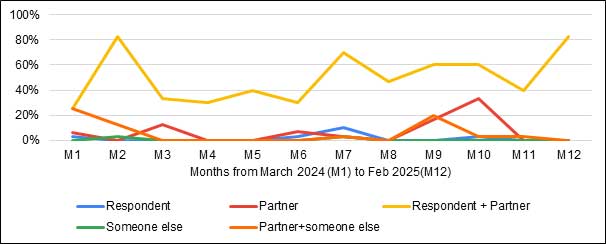
As observed from Figure 1 and Figure 2, who makes decisions fluctuates throughout the year and joint decision making is not consistently reported. In Figure 1, women most frequently report that decision making on use of income is carried out jointly by the respondents and their partners. The proportion of such joint decisions varies across the months, ranging from 25% to 83% throughout the year. Joint decision making peaks in April 2024 (M2) and February 2025 (M12). Decisions made solely by the respondents, their partners, or by someone else are less common, ranging from 0% to 25% during the same period. Notably, mutual decision making appears to have improved after the eleventh month.
Figure 2, depicts the decision-making patterns of male respondents regarding use of income earned by them. It shows that a greater percentage of male respondents also report joint decision making (Respondent +Partner) ranging from 25% to 97% across the months. Joint decisions as reported by men are frequently high, peaking in April 2024 (M2) and December 2024 (M10). There are periods where the men report that their partner and someone else are making decisions about income earned which may be consistent with men migrating (during the months of July, August, and October and November of 2024.
Figure 2:Men respondents: decision making regarding use of income earned by respondent
Possible reasons for high joint decision-making in certain months such as April 2024 (M2) and February 2025 (M12) could include cultural or social events that require family collaboration, such as festivals or financial planning for making expenditures.
For instance, in April 2024 (M2) is month in which crops like wheat, mustard and pulses are harvested and sold. This period requires greater joint decision making to manage finances effectively. Similarly, February 2025 ( M12) is a month in which households in Uttar Pradesh celebrated festivals like Mahakumbh and Mahashivratri to worship lord shiva. These festivals require family togetherness and hence there is higher joint decision making in this month.
Additionally, in this month rabi season is almost ending and harvesting season is approaching which requires greater joint decision making and collaboration between the husband and his wife regarding harvesting, storage and marketing of crops.
Conversely, low joint decision-making in months like May 2024 (M3) to August 2024(M6) could reflect periods of individual freedom or reduced interaction between partners due to external factors like greater work pressure in agriculture or non-agricultural activities or personal priorities or that the partner is away for work during these seasons.
Conclusion
While joint decision-making between men and women fluctuates , agricultural decisions still largely remain male-dominated. Moreover, men and women do not always perceive decision making in the same way. Women tend to report more joint decision making than men. Questioning both men’s and women’s perspectives about decision making is necessary to fully understand how decisions are likely made and how these impact areas of interest to policymakers, program designers and implementers. Seasonal patterns, festivals, and agricultural cycles also affect how decisions are made. This can and should impact how we interpret changes in decision making power over time given the timing of the year will highly influence how men and women respond to questions on decision making.
References
1. Ahmed, N., & Hussain, A. (2004). Women’s role in forestry: Pakistan agriculture (pp. 79–81). Agriculture Foundation of Pakistan.
2. Chayal, K., Dhaka, B. L., Poonia, M. K., Tyagi, S. V. S., & Verma, S. R. (2013). Involvement of farm women in decision-making in agriculture. Indian Research Journal of Extension Education, 13(1), 41–45.
3. Khasa, S. (2017). Role of women in decision making in household and agriculture activities: A case study of village Sanghi in Rohtak district, Haryana. International Journal of Creative Research Thoughts (IJCRT), 5(2), 392–396
4. S M Sehgal Foundation. (2023, January 9). Contribution of women in agricultural development. https://www.smsfoundation.org/contribution-of-women-in-agricultural-development