Same Code, Unequal Pay: The Gender Divide in the Tech Workforce
31-07-2025


Even though India is experiencing rapid digitalisation, the technology sector still mirrors the significant pay/opportunity imbalances characteristic of deep gender divisions. Women, and in particular Dali, and Muslim as well as other marginalised groups are still underpaid, under-promoted, and quarantined to low-growth occupations. This article analyses disparities based on national data, policy analysis, and lessons learned on the ground in Gurugram. It holds that workplace cultures, unclear compensation practices and marginal policing of equity legislations perpetuate exclusion. The piece ends with a proposal for a structural reform agenda, including a pay audit, salary-inclusive employment requirements, and gender-sensitive skilling, a global approach to go past tokenism in the direction of actual inclusion.
Section 1: Introduction
Even though the digital economy in India is rapidly growing, women and gender minorities are underrepresented and underestimated in the workforce of the technology industry. Women encounter significant barriers to access, retention, and advancement in software development, data science, leadership, and end product design. These gaps represent not just personal choices- they are reflected in structural inequality. In its Global Gender Gap Report 2023, the World Economic Forum (2023) has ranked India 127th (out of 146 countries) on economic participation and opportunity and noted that it has huge gender gaps in science, technology and STEM.
This paper critically analyses the issues of gender-based wage gap and unequal employment in the tech industry in India in the context of the Global South. Policy reports, labour statistics, and a field-based case study in Gurugram examine how exclusion functions through wage gap, discrimination upon hiring, informal contracts, and women's populations in backend and support activities. The article concludes by offering practical solutions, including pay transparency, inclusive hiring, and gender-sensitive corporate policy, arguing that removing structural barriers is more realistic than merely adopting a token diversity practice.
Section 2: Gendered Inequality in Tech – An Indian and Global South Perspective
Although the technology field is often considered a modern place where individuals can be equal based on their merits, gender inequality exists. It is widespread, especially in countries in the Global South. In India, the proportion of women in the tech workforce is only 36 per cent, and the number of women declines dramatically at mid-career and management ranks (NASSCOM, 2022). Most women are employed in low-wage, low-status jobs like testing, UI/UX support, or backend maintenance, whereas men take core, AI, cybersecurity, and leadership paths. Despite their qualifications and experience, individuals exhibiting unconscious bias during the hiring process are often given poor initial wages and excluded from unofficial mentorship, project distribution, and assignment circles.
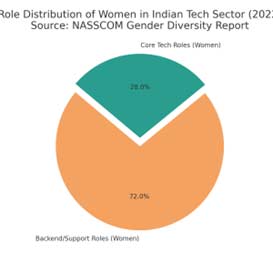
Figure 2: Distribution of women across backend/support and core tech roles in India’s tech workforce (2022).
Source:NASSCOM, Gender Diversity Report.
That is also reflected in wage data. Monster.com includes the Salary Index Report (2023), in which the average salary of a male tech worker in India is 14.6 lakhs per annum. In contrast, the average salary of a female employee with the same job and similar qualifications is 10.2 lakhs per annum, resulting in a gender pay gap of more than 30%. There is an even bigger schism in startups, gig-based tech services, and outsourced platform work, such as content moderation or data annotation, where informal hiring is the norm and there is no labour protection.
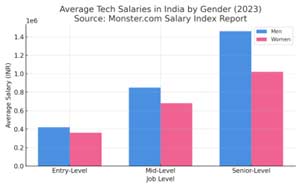
Figure 1: Average annual salaries in the Indian tech sector by gender and job level (2023).
Source:Monster.com, Average annual salaries in the Indian tech sector by gender and job level (2023).
The same goes for nations in the Global South or other countries with demographics such as Brazil, South Africa, and Indonesia. According to UN Women (2022), women are overrepresented in digital gig work, characterised by low pay, underrepresented in STEM training and workforce and underrepresented in tech leadership. Even in India, the Dalit, Adivasi, Muslim, queer, and disabled women form is mostly missing even in formal tech spaces where there are diversity agendas. The reason behind their marginalisation is not only due to their lack of education, but it is also due to discriminatory hiring policy, unhealthy work environments, game-work access, and a shortage of pathways to leadership. We can see the workings of the tech economy re-creating inequality through this amalgamated set of barriers manifesting through meritocracy.
Section 3: Fieldwork Insight – Case Study from Gurugram’s Tech-Adjacent Workforce
In March 2025, as part of fieldwork in Gurugram, I interviewed a Scheduled Caste woman, Shalini (31), who was in the backend support division at a logistics company that operated using technology. At five years of experience, she earns 16,000 per month, whereas her less qualified male colleague, who has been promoted twice, earns 22,000. People say he can handle pressure and speaks up more in meetings. I handle four systems and work on two shifts, but I am told I should wait," she said. There is no gender equity policy or formal appraisal system. Thus, promotions are based on informal networks and the whims of the supervisors, which provide no avenues to Dalit, Muslim and rural women.
Section 4: Policy Gaps and a Roadmap for Structural Inclusion
Despite being in a state of economic growth and digitalisation, disparities in gender remuneration persist in the Indian high-tech sector after decades, revealing a critical policy and institutional gap. Diversity dashboards driven by CSR can be taken as a sign of intent. Still, unless binding regulations are created, discrimination in a more informal area of pay and promotions will remain free.
The Equal Remuneration Act (1976) prohibits payment differences in India to narrow salary disparities; however, the law is only loosely followed, with startups and gig companies using contract workers to get around it. The 2019 Code on Wages is ambiguous, and the absence of clear mechanisms, such as monitoring and penalty systems, promises parity.
Flagship projects such as Digital India, Startup India, and Make in India are also not gender mainstreamed, and they barely mention the inclusion of the SC/ST, OBC, Muslim, or queer communities into the field of technology or entrepreneurship.
In firms, the POSH Act Internal Complaints Committees are currently inactive on matters of pay disparities or promotional discrimination. Devoid of any legal obligation to disclose salaries and with a greasy hiring process, women, particularly those with no elite social capital, cannot enjoy the benefit of fair pay and growth.
Roadmap for Structural Change
Gender equity in the tech industry in India requires a structural intersectional transformation, which can only be measured by pay. The government should require an annual gender pay audit, including disaggregated publicly reported numbers. Incentives such as tax concessions and grants should be measured with specific diversity aims of Dalits, Adivasis, Muslims and LGBTQ individuals. Wage bias and promotion obstacles are also crucial problems that have to be solved by the Internal Complaints Committees. Women in tech should be publicly registered and monitored for hiring and salaries. Skilling programmes must be gender sensitive, where mentorship and job placement are provided within the training programme. Gender equity in the digital economy cannot be more than a noble notion unless it is profoundly restructured.
Section 5: Conclusion and Key Takeaways
No form of digital economy that is gender-diverse can be constructed without considering the issue of role segregation, wage disparities, and systematic discrimination that have, over time, defined the experiences of women in the Indian tech industry. According to national data and field experiences of Gurugram, Dalit women, Muslim women, and migrant women are not only underpaid and under-recognised but also not a part of the leadership. Structural privilege is frequently confused with rhetorical meritocracy based on caste, class, gender, and geography. Corporate diversity programs are not binding policies, are characterised by a lack of demographic breakdown, and are just cosmetic.
This is widely practised in the Global South, where women occupy low-paid, low-skill digital work, often informal and non-unionised, and do not occupy higher-paid, skilled jobs (UN Women, 2022). India can take the lead and institutionalise wage transparency, fair access, and greater accountability in tech jobs, not with a slogan, but with tangible governmental standards that can be measured.
Gender equity in tech is as much about what is right as it is about the core of innovation, sustainability and democratic justification of the digital economy in India. In its absence, the code can still be executed, but an elite group will retain the keys.
References
NASSCOM. (2022). *Women in Tech Report*. National Association of Software and Service Companies.
Monster.com. (2023). *India Salary Index Report*. Retrieved from https://www.monsterindia.com
UN Women. (2022). *Gender Equality and the Digital Economy in the Global South*. United Nations Publications.
World Economic Forum. (2023). *Global Gender Gap Report 2023*. Retrieved from https://www.weforum.org/reports