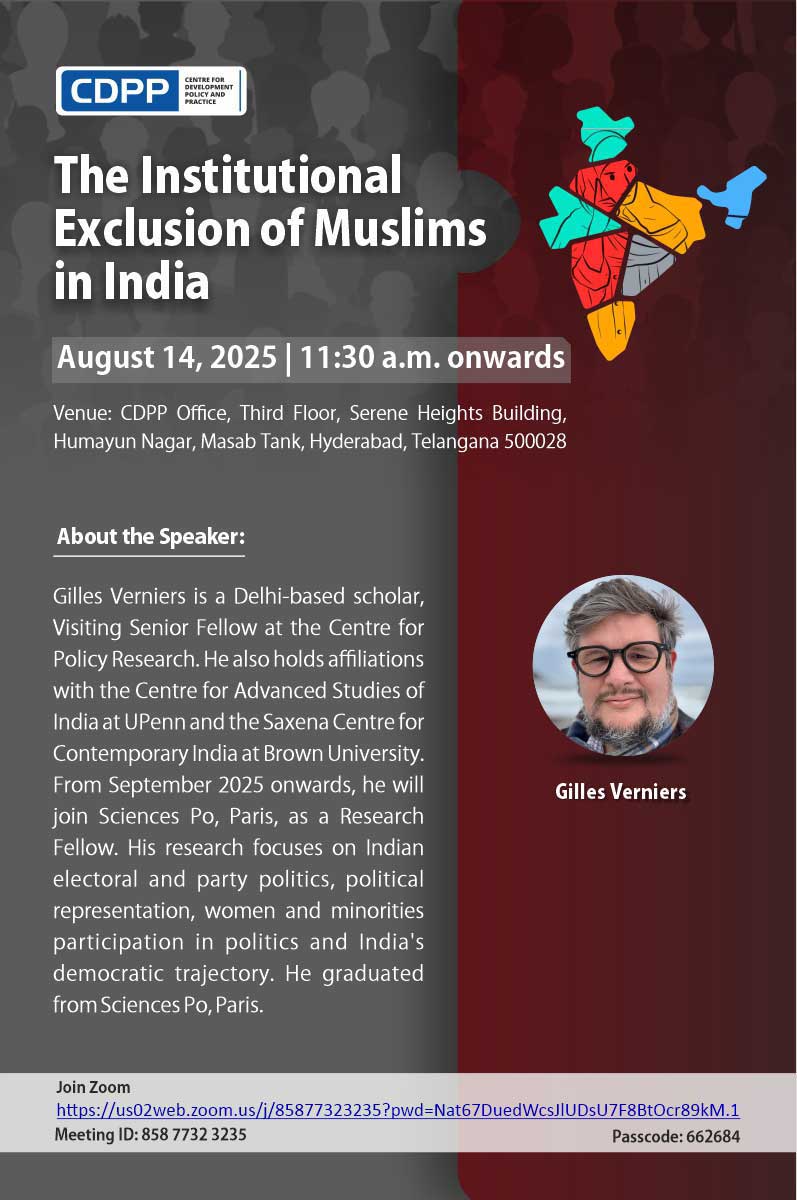
Date & Time: August 14, 2025 | 11:30 a.m. onwards
Venue: CDPP Office, Third Floor, Serene Heights Building, Humayun Nagar, Masab Tank, Hyderabad, Telangana – 500028
Event Description:
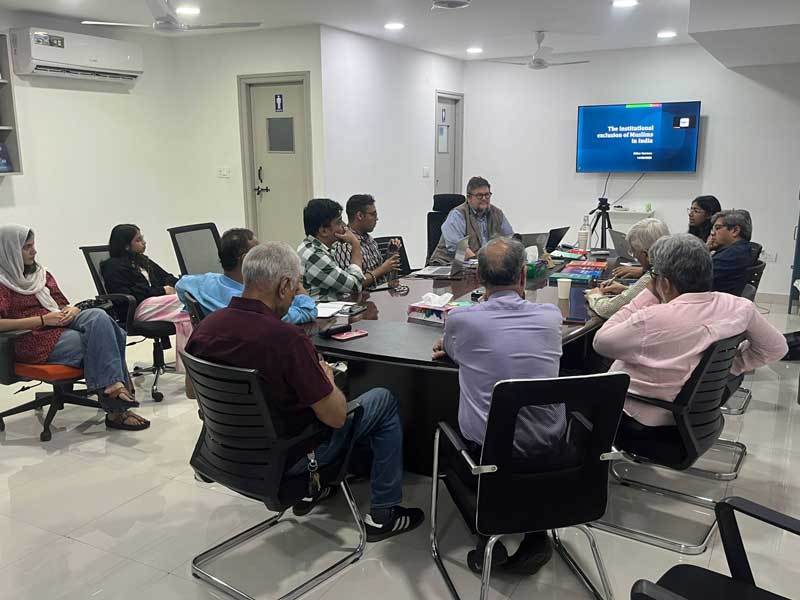
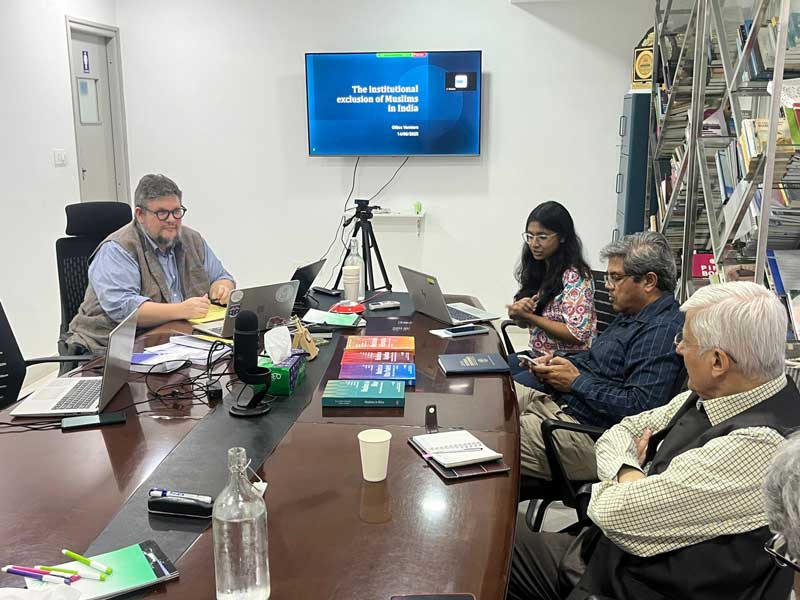
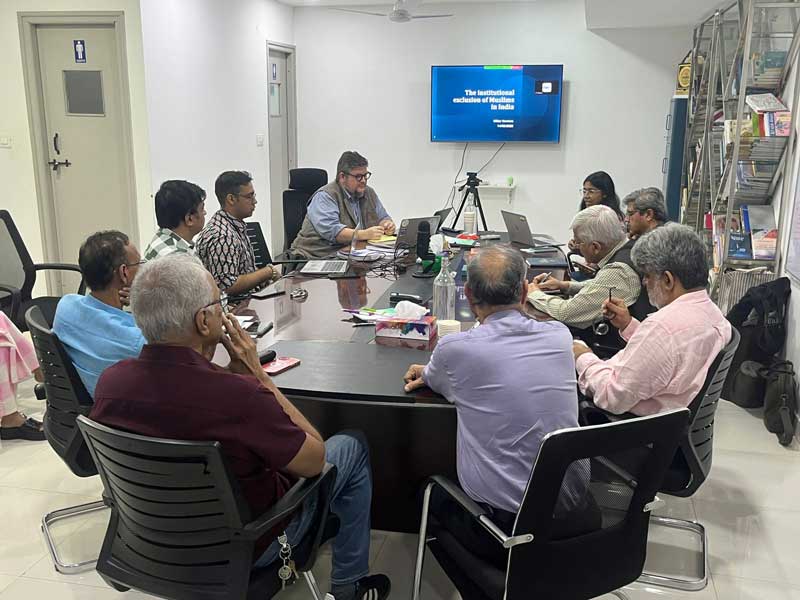
On August 14, 2025, the Centre for Development Policy and Practice hosted a thought-provoking lecture by Gilles Verniers, titled The Institutional Exclusion“The Institutional Exclusion of Muslims in India.” Mr. Verniers, a Delhi-based scholar and Visiting Senior Fellow at the Centre for Policy Research, will soon join Sciences Po, Paris as a Research Fellow. His research focuses on Indian electoral politics, political representation, and the participation of minorities and women in democratic life.
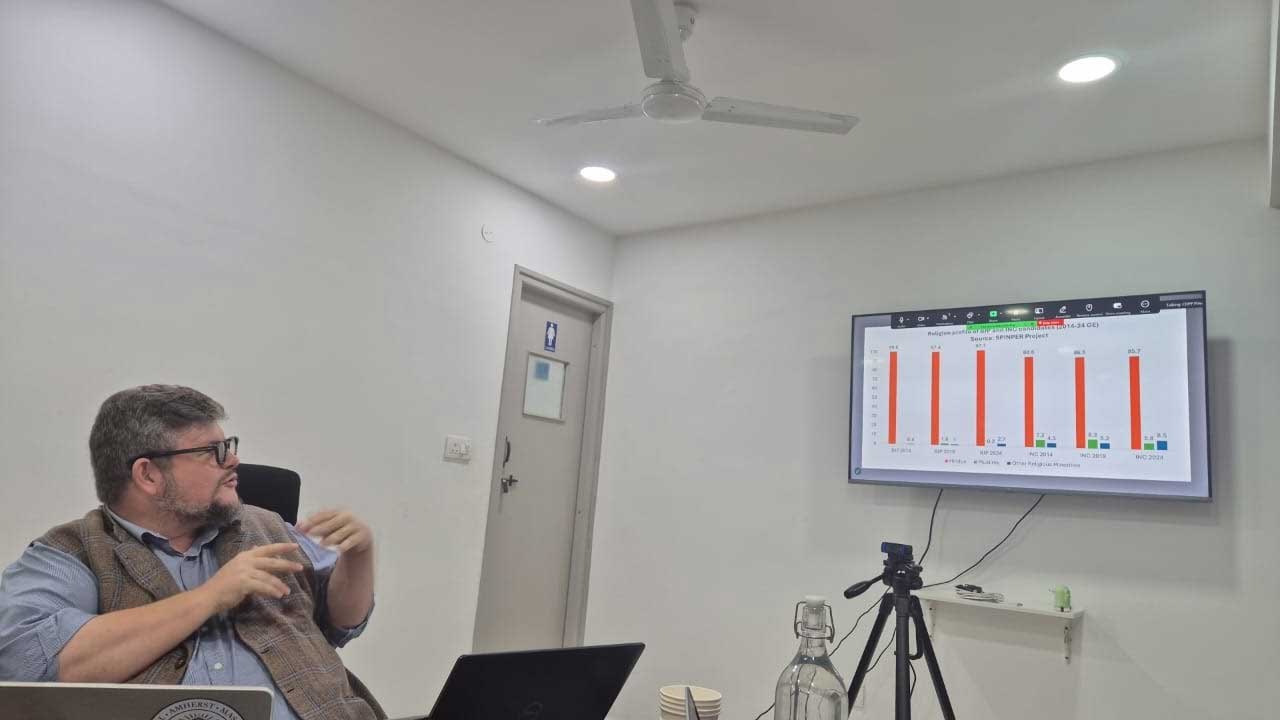
Drawing on data from the SPINPER project and other sources, Mr. Verniers showed that although more Muslims are contesting elections, their chances of success have declined due to political parties systematically denying them tickets. This decline has been especially sharp since 2014. For example, between 2014 and 2024, the BJP fielded 101 Muslim candidates, mainly from Jammu and Kashmir and Assam, but only five were elected. Other parties, too, have reduced Muslim nominations, creating a systemic pattern of marginalisation.
He identified three dynamics underpinning this exclusion:
(1) barriers to entry in politics, including high costs and elitist recruitment practices;
(2) weak institutional support from within Muslim parties, often concentrated in a few leaders; and
(3) short-lived political careers, with most Muslim MPs serving only one term.
Muslim women, he emphasised, remain the most politically excluded, with declining candidatures and representation across parties.
Turning to non-elective institutions, Mr. Verniers traced a steep decline in Muslim presence. Representation in the Rajya Sabha fell below 5% by 2023, while the Union Cabinet today has no Muslim ministers. In the bureaucracy, Muslims constitute just 4% of IAS and 3% of IPS officers, largely concentrated in Kashmir. In the judiciary, where Muslims made up 12% of judges in 1947, the number has dropped to 4% in 2024. Of 341 Supreme Court judges in India’s history, only 23 have been Muslim.
Mr. Verniers linked these institutional patterns to broader socioeconomic outcomes. Muslims earn, on average, only a quarter of Hindu incomes, hold 7% of government jobs, and face declining higher education participation. Unlike many disadvantaged groups, they are not substantially included in affirmative action frameworks.
The lecture devoted particular attention to the judiciary, highlighting how representation is not merely symbolic but essential to fairness, diversity, and public trust in democratic governance. Currently, Muslims constitute only 5.5% of judges across 25 high courts, with representation heavily concentrated in Jammu and Kashmir. Prominent courts such as Madras, Calcutta, and Madhya Pradesh average less than 6%, while some—like Punjab & Haryana and Manipur—record virtually no representation.
Mr. Verniers argued that the institutional exclusion of Muslims is not new but has intensified in recent years, compounding socioeconomic marginalisation. Without descriptive representation in institutions of power, communities remain invisible to the state, excluded from resources, and denied equal citizenship in practice.