NFHS-6: What the Latest Health Survey Tells us about India’s Current and Future Trajectory
18-06-2026

The National Family Health Survey (NFHS) 2023-24 recently released the much-awaited 6th edition of India’s most comprehensive health data. Conducted by the International Institute for Population Sciences (IIPS), New Delhi, the study collected data from around 679,238 households, with 716,397 women, and 100,977 men (NFHS-6 2023-24 Fact Sheet India, 2026). By replacing Census Enumeration Blocks (older census-based divisions of cities) with Urban Frame Survey blocks (newer, survey-specific divisions of cities) in the first stage of urban sampling, IIPS gathered data from 715 districts across India ensuring the sample collected was representative of the current urban areas.
NFHS-6 data brings to the forefront India’s success on the structural health deficits of the 20th century with institutional deliveries, basic immunisation coverage, and chronic childhood stunting, while simultaneously exposing the lifestyle-driven, non-communicable epidemics of the 21st century.
Small Yet Significant Triumphs
Institutional deliveries have been widely considered a stepping stone towards strengthening maternal public healthcare system. The goal has always been to get the deliveries out of dimly lit homes and into a hygienic, professional medical facility. NFHS-6 data reveal that India has crossed that checkpoint, with institutional deliveries surging to 90.6%, up from 88.6% in NFHS-5. About nine out of ten children (91%) have been reported to be born in the hands of skilled health personnel, and nearly 88% received postnatal care within the first two days of birth (NFHS-6 2023-24 Fact Sheet India, 2026).
This structural victory, reinforced by an expansion of the state-sponsored financial safety net – marked a milestone. Driven by welfare policies, the share of households covered by some form of health insurance or financing scheme rose steeply from 41% to 60%, a leap forward with the promise to protect vulnerable households from the burden of out-of-pocket medical expenses.
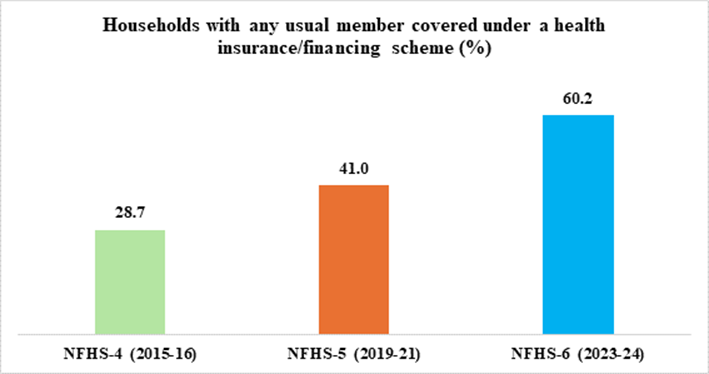
Source: Press Information Bureau (PIB), 2026
Paediatric immunisation under the Universal Immunisation Programme escalated full vaccination coverage for children aged 12–23 months from 83.8% to 87%. The targeted deployment of the Rotavirus vaccine exploded from a baseline of 36.4% reported in NFHS-5, to a near-universal coverage of 85.4% in this survey (NFHS-6 2023-24 Fact Sheet India, 2026).
The Disparities and the Changes
NFHS-6 highlights long-term, structural interventions in sanitation, maternal care, and rural development, which in turn help shift the needle towards meeting basic healthcare needs. Child Stunting (low height-for-age) fell substantially from 35.5% as reported in the NFHS-5 to 29.3% in NFHS-6, indicating chronic, long-term undernutrition. Severe Wasting (too thin for height), which reflects acute, life-threatening malnutrition, dropped sharply from 7.7% to 5.2%.
Despite these victories, the system still fails. Starvation indicators and underweight rates barely improved, with marginal improvement from 32.1% to 31.8%. Added to this, crucial data points are visibly missing from the current survey, including anaemia prevalence, vital statistics like sex ratio and mortality rates, cancer screening, sanitation, and clean cooking fuel. These gaps reveal how a few progress points mask systemic weaknesses. Persistent malnutrition, hidden micronutrient deficiencies, unmonitored non-communicable disease risks, and environmental health burdens persist.
Why is the general weight-for-age metric failing to budge when stunting and wasting are going down?
The answer lies in the micro-level realities of child-feeding practices. While early initiation of breastfeeding within one hour of birth rose to 50%, exclusive breastfeeding for the first six months suffered a sharp drop from 63.7% down to 55.8%.
An alarming fact emerges: an astonishingly low (15%) children aged between 6-23 months receive an adequate diet, keeping them alive and preventing them from dropping below severe structural height thresholds, but this in turn fails to feed them a nutrient-dense, balanced diet during their most critical windows of cognitive and physical development.
The C-Section Crisis: The Privatised Answer to Childbirth
While India has successfully stabilised its population replacement level with a consistent Total Fertility Rate (TFR) of 2, the means by which this is achieved suggest an underlying regression in public health awareness.
The absolute reliance on modern contraceptive methods surprisingly dropped from 56.4% to 52.7%, while a simultaneous jump was recorded in traditional methods (16.4%). This trend reveals a potential gap in grass-roots public health communication, reproductive agency, or supply chain reliability for modern contraceptives, forcing couples to rely on less reliable traditional methods despite stable overall fertility rates.
Perhaps the most alarming red flag raised by NFHS-6 is the relentless, unregulated medicalisation of childbirth. The World Health Organization (WHO) has long maintained that the optimal rate for Caesarean section (C-section) deliveries lies between 10% and 15% of all births. Beyond this threshold, C-sections cease to be life-saving interventions and instead become unnecessary surgeries that introduce avoidable risks for both mother and child (WHO, 2015).
India’s national C-section rate jumped to 27.2%, up from 21.5% in NFHS-5. In urban centres, this number reached a staggering 40%.
| Healthcare Facility Type | C-Section Rate | |
|---|---|---|
| NFHS-5 | NFHS-6 | |
| Public | 14.3% | 16.9% |
| Private | 47.4% | 54.1% |
Source: NFHS-6 2023-24 Fact Sheet India, 2026
In private clinics across India, pregnant women now have more than 50% chance of being rolled into an operating theatre for a surgical birth. This is no longer a rare clinical event, rather an economic strategy. The wide gap between public and private rates reflects financial incentives, systemic over-medicalisation, defensive medicine, and a profound lack of regulatory oversight. Childbirth in India's private sector has turned into a commercialised commodity, and our public health framework is failing to protect women from unnecessary surgeries.
Digital Inclusion
An important factor emerging from the NFHS-6 data was the rapid rise in digital and financial empowerment among women, with the underlying message that maternal and child health outcomes are far better equipped to demand quality healthcare for themselves and their offspring. The data documents a truly massive digital leap. The percentage of women who have ever used the internet has nearly doubled, surging from 33.3% to 64.3%. Similarly, the proportion of women who independently own and operate a mobile phone rose from 53.9% to 63.6% (NFHS-6 2023-24 Fact Sheet India, 2026).
This digital connectivity is translating into direct financial autonomy. Women with an active bank or savings account they themselves use has reached 89%, up from 78.6% in the previous round. This financial inclusion directly aligns with the expanded scope of the survey schedules, which, for the first time, tracked Direct Bank Transfers and Self-Help Group coverage. When the state deposits maternal health benefits, nutritional cash incentives, or welfare stipends directly into a woman's phone-linked bank account, it also bypasses the traditional patriarchal gatekeepers.
The Ticking Time Bomb
The most urgent warning within NFHS-6 is that India is slowly walking into a massive, dual-burden health crisis. Even as we struggle to feed 15% of our infants an adequate diet, our adult population is rapidly expanding into levels of metabolic distress that our primary healthcare system is wholly unprepared to handle.
The numbers are terrifying. The proportion of women aged 15–49 who are overweight or obese has hit 30.7%, climbing from 24% in NFHS-5. In urban areas, this crisis has exploded into the mainstream: 42.8% of urban Indian women are now overweight or obese. Men are tracking along the exact same trajectory, with adult male obesity rising from 22.9% to 27.3% nationally, and peaking at 36.3% in cities. The explosion of body mass index (BMI) is directly driving a corresponding surge in chronic illness. The prevalence of high blood sugar among women has jumped from 13.5% to 17.8%, with urban women touching an alarming 21.9%. Our changing food systems, flooded with ultra-processed, calorie-dense foods combined with increasingly sedentary urban lifestyles, have outpaced our public health messaging. India is now trapped in a dangerous pincer movement: we are simultaneously fighting the residual battles of severe undernutrition in early childhood and the escalating costs of cardiovascular disease, stroke, and diabetes in adulthood.
The Verdict: Policy Must Move Beyond the Hospital Walls
TFR across India has stabilised firmly at 2.0, safely below the population replacement threshold of 2.1. This confirms that India's demographic transition is mature; our population growth is slowing, and the era of the demographic explosion is officially over.
Clinics/hospitals/ nursing homes are expanding rapidly, yet private doctors who perform unnecessary surgeries on more than half their patients remain unregulated. While distribution systems to combat severe stunting have been established, the crucial step of educating parents on proper infant feeding between 6 months and 2 years of age is neglected. At the same time, efforts to build an economic engine for financial inclusion has created an unregulated food ecosystem, pushing nearly half of the urban population, especially women, into metabolic illness.
Moving forward, India's public health strategy must pivot away from merely tracking hospital admissions and toward structural behaviour change. This means, instating aggressive regulations on commercialised private healthcare to stop the C-section epidemic, directing massive public health campaigns toward dietary quality and infant feeding practices, and shifting focus from simply keeping our citizens alive to ensuring they have the better lifestyles to thrive.
References
International Institute for Population Sciences. (2026). National Family Health Survey (NFHS-6), 2023-24. Fact Sheet India. Ministry of Health and Family Welfare, GOI. New Delhi.
World Health Organization. (2015). WHO Statement on Caesarean Section Rates. WHO. Geneva.
https://iris.who.int/server/api/core/bitstreams/475b39fc-240b-462d-a5e1-429401c98a79/content
Press Information Bureau. (2026). Union Health Ministry Releases National Family Health Survey – 6. Ministry of Health and Family Welfare, GOI. New Delhi.
https://www.pib.gov.in/PressReleasePage.aspx?PRID=2266600®=3&lang=1