Gender diversity and inclusion in the tech industry
30-06-2025

This blog explores the persistent gender gap in the global tech industry, tracing its roots from early education to biased AI tools. It highlights how structural barriers exclude women from STEM and leadership roles, despite evidence that diversity drives innovation and economic growth. Using powerful real-world examples, from facial recognition failures to Amazon's
flawed AI hiring tool, it argues that gender inclusion is not just a moral imperative but essential for just and effective technological progress. The piece calls for systemic reform in education, policy, and workplace culture to ensure inclusive innovation
Introduction
From hunter-gatherers to artificial intelligence, humans have made tremendous progress in science and technology. But one injustice that has been persistent throughout time is the issue of gender equality. Despite all our progress, we continue to struggle to give people of all
genders equal respect, opportunity, and voice. Advancement means nothing if people are left behind. (Radulovski, 2025) shows, only 42%, less than half of working-age women,
participate in the global workforce. They are paid less and promoted slowly because of their gender. This is not accidental, this is systematic!
The numbers are alarming when it comes to the sector that shapes our future - high-paying tech jobs. In the United States, one of the most advanced economies in the world, women make up just 35% of the STEM (Science, Technology, Engineering and Mathematics)
workforce. Global tech companies, specifically, Amazon, Facebook, Apple, Google and Microsoft reported that the proportion of female staff is around 36% on average. In
leadership positions, the number falls around 30%, highlighting the disparity (Radulovski, 2025)!
At a glance, it may seem like the problem begins at the hiring stage. But that’s far from the
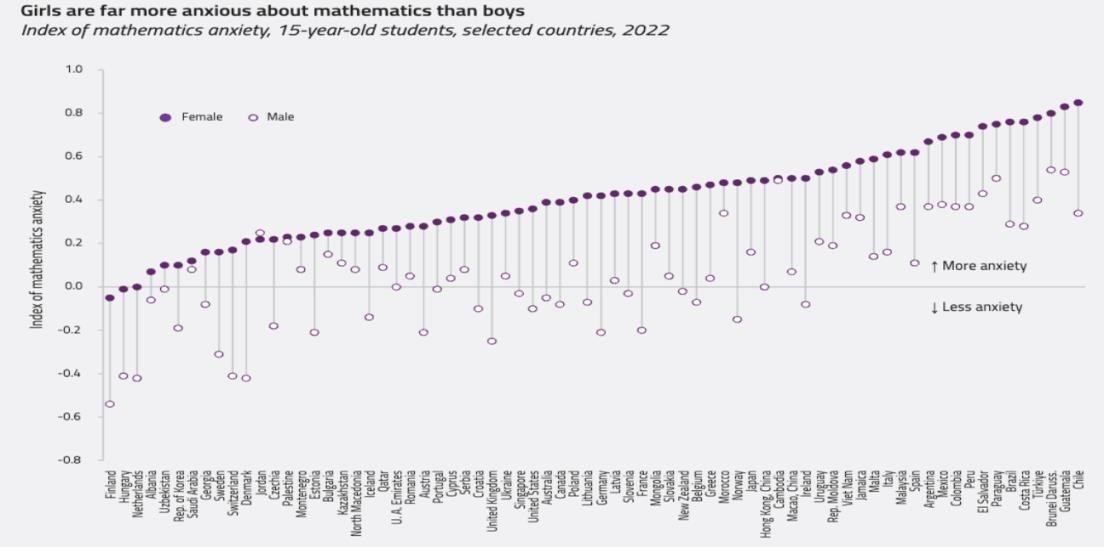
truth. Gender inequality in tech doesn’t start with recruitment; it begins with childhood. From early childhood, girls are subtly and often blatantly conditioned to believe that science and technology are “boys’” domains, while girls are suited for softer paths. This isn’t a claim, it’s a global reality backed by data. The annual status of education report India 2023 shows that
females are less likely to be enrolled in STEM courses (28.1%) than males (36.3%).
According to UNESCO, women make up only 35% of STEM graduates worldwide, and this has not changed in the last ten years. The reason is that girls’ confidence is shaken early in life, and they are less confident than boys even when they perform well!
But why does gender diversity matter in the tech sector? If this question crossed your mind, it’s exactly why this conversation is urgent. The issue has moral, social, managerial and
economic implications! (Talkspace, 2024) argues that diverse teams are more productive, innovative, engaged and effective problem solvers. Beyond all this, the economic case is undeniable. An increase in female labour in the tech sector is a huge economic gain to
society. According to a UNESCO report, doubling the share of female employees in the tech sector by 2027 could boost GDP by EUR 600 billion.
The 21st century is the age of automation, artificial Intelligence and machine Learning.
Employees are being replaced by AI tools, under the assumption that AI tools are much more capable, faster and fairer. But is that really true? Not quite. AI systems are as fair as the data they are trained on, and when the data reflects real-world bias, the technology does too!
Take the case of Amazon’s AI recruitment tool. In 2014, Amazon built AI programs to review job applicants’ resumes to hire top talent quickly but within a year, it was clear that the new system was not functioning in a gender-neutral way because Amazon’s computer models
were trained to shortlist applicants by observing patterns in resumes submitted to the
company over a 10-year period. Most came from men, which created bias in the algorithm, and the system taught itself that male candidates were preferable and downgraded the
résumés with the word “women”. This is a textbook example of highlighting the urgent need for diversity in the tech sector, and otherwise, our innovations will also contribute to creating an unjust world!
One might assume facial recognition software is impartial, but that’s far from reality. The
groundbreaking “gender shades” study by Buolamwini and Gebru revealed a horrifying truth: all face recognition systems perform better on male faces than female faces, all perform better on lighter faces than darker faces, and worst of all, perform worse on darker female faces
(20.8%-34.7%). This is not just a technical glitch but a coded exclusion by design! We need heterogeneity in teams building the technology to make the world a just place for all! Only then can we ensure that innovation truly works for everyone.
If you have made it this far, you are probably already convinced: diversity in tech is essential. You are likely asking about the possible ways to create a just world regardless of class, race and gender. It’s time to shift from diagnosing the problem to building the solution.
They say you are what you consume, be it food or information. What we see and hear shapes how we see ourselves. This being said, schools must provide strong female role models, and girls need to see women succeeding in STEM fields to boost their confidence. Career counselling can help girls see STEM pathways they would not have considered otherwise, simply because no one ever told them they could do it.
Schools must train teachers to challenge bias, use gender-neutral language, and introduce
relatable examples. Evidence from 2015 TIMSS data shows that students, especially girls and those from disadvantaged backgrounds, perform significantly better in science when taught by subject-qualified and confident teachers, particularly female teachers.
In today’s time Digital literacy has become foundational and it should be approached with a gender lens. But across the globe, girls face a growing digital divide that limits their access to the skills and tools necessary to thrive in tech. A key solution is to establish a clear digital
skills framework that all learners, regardless of gender, must master, including critical components like online safety, digital problem solving and coding.
Gender diversity in tech is not a side issue, it is central to building a future that works for everyone. If we want development that is inclusive, intelligent and fair, then we must remove the barriers that keep women and marginalised genders out of STEM. This is a slow process, but it begins with intention: with classrooms that empower, companies that listen, governments that invest and individuals like you who care enough to act. The question is no longer whether we need gender diversity in tech. The question is, what are we doing to make it happen? Let us come together and ensure that the next wave of innovation is built by everyone, for everyone!
References
1. Radulovski, A. (2025, March 11). Women in tech stats 2025. Women in Tech Network. https://www.womentech.net/women-in-tech-statshttps://www.womentech.net/women-in-tech-stats
2. ASER 2023: Main findings. Annual status of education report. (2023). https://asercentre.org/wp-content/uploads/2022/12/ASER-2023_Main-findings-1.pdf
3. Dastin, J. (2018). Insight - Amazon scraps secret AI recruiting tool that showed bias against women | reuters. Reuters. https://www.reuters.com/article/world/insight-amazon-scraps-secret-ai-recruitingtool- that-showed-bias-against-women-idUSKCN1MK0AG/
4. Unesdoc.unesco.org. (2024). https://unesdoc.unesco.org/ark:/48223/pf0000179018/PDF/179018qaa.pdf.multi
5. Buolamwini, J. (2018). Project Overview ’ gender shades. MIT Media Lab. https://www.media.mit.edu/projects/gender-shades/overview/
6. Talkspace. (2024). The benefits of gender diversity in the Workplace. https://business.talkspace.com/articles/gender-diversity-in-the-workplace